TerritóRios ProjectTerritorial defence and community leadership for climate justice
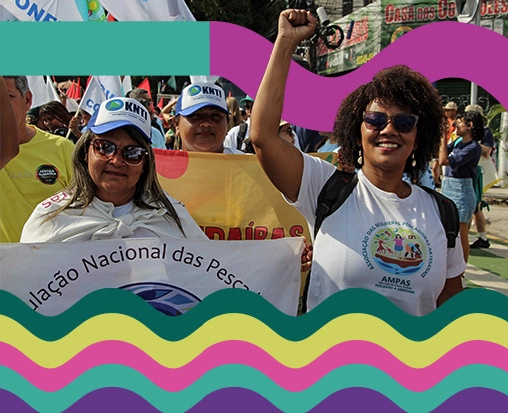
By the river’s edge, women protect the world
TerritóRios is an initiative by ActionAid Brazil that empowers communities historically affected by environmental racism, gender inequalities and the climate crisis in Brazil.
The project works to expand processes of training, protection, community mobilisation and policy advocacy in vulnerable territories, strengthening communities in the defence of their rights, ways of life and permanence in their territories.
Through initiatives such as citizen-generated data, the development of social cartographies and consultation protocols, TerritóRios transforms community knowledge into evidence, tools for territorial defence and collective strategies of resistance.
More than responding to violations, the initiative strengthens communities’ capacity to protect their territories, participate in decisions that affect their lives, and expand their advocacy in local, national and global agendas on climate justice, racial equity and territorial rights.
The challenge
Environmental racism and gender inequalities put territories and lives at risk
In Brazil, the impacts of the climate crisis do not affect everyone in the same way. Black, Indigenous, Quilombola, fishers, shellfish gatherers, family farmers, peripheral and other traditional peoples and communities are among those most affected by lack of access to land, water, sanitation, territorial security and participation in decisions that affect their lives.
Black women, community leaders and youth are on the frontline of defending life, waters, biomes and territories. Yet they remain historically invisibilised and exposed to multiple forms of violence.
Unequal climate crisis
Environmental impacts affect historically vulnerable populations more severely.
Environmental racism
Racialised communities face violations of territorial, environmental and social rights.
Political invisibility
Women, youth and traditional peoples still have limited participation in decisions about their territories.
The TerritóRios project works to address this situation by strengthening community organisation, collective protection and evidence-based political advocacy produced by the communities themselves.
Our response
Data, maps and protocols produced by those who live the territory
TerritóRios is based on a central premise: those who live in the territory know its threats, its strengths and its pathways for transformation. For this reason, the project values local knowledge and strengthens communities as producers of data, narratives and solutions.
Participatory methodologies for advocacy
Through Citizen-generated Data, rights holders take part in developing assessments, mapping violations and opportunities, analysing information and mobilising the results to defend their rights.
This process gives rise to concrete tools for resistance and advocacy, such as social cartographies and community protocols for free, prior and informed consultation, in accordance with ILO Convention 169.
A community-based, networked approach connected to the world
The TerritóRios project combines participatory methodologies, network-building and political advocacy to support communities in defending their rights.
Knowledge produced in the territories
The project breaks with historical invisibility by producing data directly with communities, valuing local knowledge and strengthening its legitimacy in processes of dialogue, denunciation, negotiation and advocacy.
Evidence-based territorial defence
Social cartographies and consultation protocols qualify community action, map territories, document violations and reinforce demands for participation in public and private decision-making.
Leadership of women and youth
Black women, community leaders and youth are recognised as central political actors in the defence of territories.
Network mobilization
The project connects communities, local organisations, social movements, civil society, public authorities and national and international networks.
Local, national and global connection
ActionAid helps connect territorial struggles to global agendas on climate justice, racial equity, territorial rights, protection of women human rights defenders and the reduction of inequalities.
Who leads the transformation
Women, youth and communities on the frontline
The TerritóRios project is built with women, youth and leaders from urban, Quilombola, fishing, shellfish-gathering, farming and traditional communities.
Despite being historically invisibilised, Black women have been protagonists in the training, mapping, mobilisation and advocacy processes carried out by the project.
Of the 2,475 people trained in the project’s first year, 70% were women, 76% were Black people and 52% were Indigenous, Quilombola or from other traditional peoples and communities.
These leaders produce data, build consultation protocols, mobilise their communities and connect local knowledge, collective action and tools for territorial defence.
Strands of Action
How TerritóRios strengthens communities
Community training and mobilisation
Training on territorial rights, climate justice, racial equity, gender, social participation and protection of women human rights defenders.
Citizen-generated data
Development of diagnostics, social cartographies and evidence on violations, threats, strengths and ways of life in the territories.
Consultation protocols and territorial defence
Support the creation of free, prior, and informed consultation protocols, strengthening community participation in decisions that may affect their territories.
Protection of women defenders
The initiative contributes to strengthening community-based and networked protection mechanisms, especially for women, youth and leaders exposed to threats and violations.
Advocacy and communications
Data, narratives and evidence produced in the territories are mobilised in spaces for reporting, dialogue, articulation and public policy formulation, connecting local demands to national and global agendas.
Connection with global agendas
These lines of action contribute directly to achieving the Sustainable Development Goals (SDGs) established by the United Nations (UN):
SDG 2Zero Hunger and Sustainable Agriculture
SDG 5Gender Equality
SDG 6Clean Water and Sanitation
SDG 11Sustainable Cities and Communities
SDG 16Peace, Justice and Strong Institutions
Impact
Reach and results
The TerritóRios project operates in 40 municipalities across 9 Brazilian states, covering territories in the Northeast, Southeast and Amazon regions, within rural, traditional and urban peripherial communities.
In its first year of activity, the project contributed to strengthening community autonomy, increasing the visibility of historically marginalised populations and creating concrete foundations for policy advocacy, collective protection and the defence of rights.
The result is a stronger, more visible and better-connected network of communities able to produce evidence, defend rights, influence decisions and protect life within their territories.
Results achieved in 2025
8,354 people impacted
2,475 people trained
Over 47 activities conducted
5 social cartographies produced
4 consultation protocols developed
An expanding network for the defence of territories
By combining community action, territorial evidence and local-national-global networking, the project offers an approach with strong potential for scaling and policy advocacy.
The participatory methodologies developed by TerritóRios can be adapted and replicated across diverse urban, rural, Indigenous, Quilombola, and traditional community contexts in Brazil.